
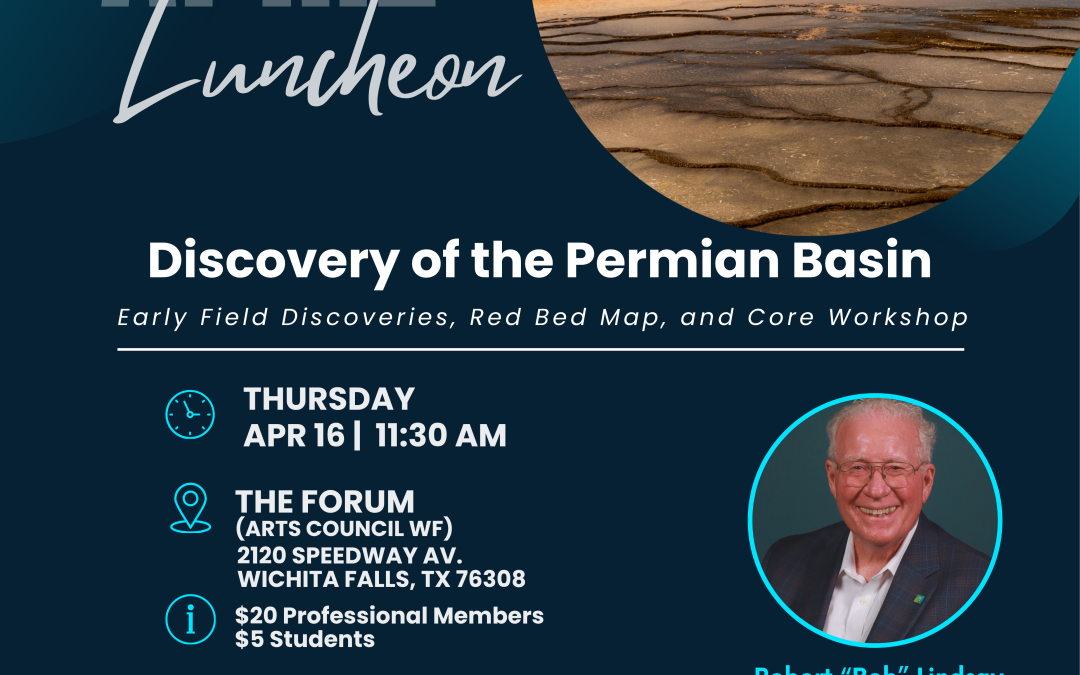
SPEAKER: Robert F. Lindsey, Lindsey Consulting, LLC
TITLE: Discovery of the Permian Basin, Early Field Discoveries, Red Bed Map and Core Workshop
ABSTRACT: In the 1850’s expeditions to the Guadalupe Mountains of West Texas and southeastern New Mexico discovered that the mountain range was composed of Permian age strata, with regional dip of strata to the east. In Central Texas, Permian age strata were identified, with regional dip of strata to the west. Between the Guadalupe Mountains and Central Texas it was realized that the area hosted a depositional basin of Permian age. However, the basin was covered by younger Late Permian, Triassic, Cretaceous, and Cenozoic strata. Initially the basin was called the West Texas Permian Basin, which was later shortened to Permian Basin. Now the basin is referred to as the Permian Super Basin, due to its high productivity of hydrocarbons.
First Wells
The first wells drilled in the West Texas Permian Basin were water wells on the Llano Estacado (Staked Plains) in search of artesian water in 1855-59. These water wells were drilled by Captain John Pope as part of the Railroad Survey Act. Water was needed along a proposed railroad route to supply steam locomotives. One well reached a depth of 1301 ft. Water was found, but not artesian water.
Later Wells
Little was known about the West Texas Permian Basin. In 1926 the West Texas Geological Society was chartered, along with other geological societies throughout the area where geologists could gather and compare notes trying to understand the lay of the land in the subsurface. A few exploration wildcat wells were drilled to evaluate the area. Oil seeps and shallow non-commercial oil production captivated explorationists’ minds, with the prospect of discoveries of commercial quantities of oil.
Early Shallow Field Discoveries
Westbrook Field
In June 1920, the first discovery of commercial oil in the Permian Basin was made by the Texas and Pacific W.H. Abrams No. 1, with the discovery of Westbrook field. Though not understood at the time of discovery, Westbrook was located on the eastern shelf of the Permian Basin. Lower Permian Upper Clear Fork Formation carbonate strata served as the reservoir. In the first year Westbrook produced 50,000 BO.
Big Lake Field
On May 28, 1923, the second discovery of commercial oil in the Permian Basin was made by the Santa Rita No. 1, “Patron Saint of the Impossible,” with the discovery Big Lake field. Though not understood at the time of discovery, Big Lake was located on the Ozona Arch at the southern end of the Midland Basin. Middle Permian Grayburg Formation carbonate strata served as the reservoir. In the first 1.5 years Big Lake produced 1,000,000 BO.
Artesia Field
On April 9, 1924, the third discovery of commercial oil in the Permian Basin was made by the Flynn-Welch-Yates No. 3, with the discovery of Artesia field. Though not understood at the time of discovery, Artesia was located on the Northwest Shelf. The field was next to Artesia, New Mexico, hence the field name. Middle Permian Grayburg Formation siliciclastic-carbonate strata served as the reservoir. In 1924 Artesia produced 98,000 BO. In 1925 Artesia produced 1,000,000 BO.
Exploration Potential
These three initial field discoveries of commercial oil in Lower to Middle Permian strata, spread across the Permian Basin, opened a vast area for exploration.
Red Bed Map
In the 1920’s little was known about the subsurface geology of the Permian Basin. In 1924 the Red Bed map was drawn and signed by O.C. “Kip” Harper. The Red Bed map is an isopach map of red bed facies directly above productive Middle Permian dolostone facies. Harper thought he had discovered the largest anticline in the world. What he discovered was the south half of the Central Basin Platform (CBP). The remainder of the CBP was yet to be identified by exploration wells, along with the Midland, Delaware, Val Verde basins, and surrounding shelf margins.
To his employer, Gulf Oil, Harper recommended purchasing as much acreage as possible. Gulf in turn only purchased 30% of what was recommended, which was 300,108 acres at a cost of $0.45 per acre. That acquisition solidified Gulf’s position in the Permian Basin and was followed by several field discoveries that provided the financial feed stock to enter international exploration in Venezuela, Iran, Kuwait, and West Africa. All these international ventures proved highly successful.
Early Deep Field Discovery
Big Lake Field
On December 1, 1928, the deepest well in the world, Texon University B-1, was drilled in Big Lake field and made a commercial discovery in Early Ordovician Ellenberger karstified strata. Discovery of deep reservoir potential in the Permian Basin opened the complete Paleozoic stratigraphic column to exploration, whereas earlier discoveries were limited to Lower and Middle Permian strata. And as they say, “The Rest Is History.”
Core Workshop
In 2026 the West Texas Geological Society will celebrate its 100-year anniversary. As part of the celebration a 100-year anniversary core workshop will be held that will step back in time 100 years and review core from the above four field discoveries and 13 additional early Permian Basin field discoveries made between 1920 and 1934.
To date, the core workshop will consist of cores from the following early field discoveries, including their date of discovery, and reservoir interval:
- Goldsmith (1934, San Andres)
- Westbrook (1920, Upper Clear Fork)
- Big Lake (1923, Grayburg)
- Artesia (1924, Grayburg)
- McElroy (1925, Grayburg)
- McCamey (1925, San Andres & Grayburg)
- Wheat (1925, Brushy Canyon)
- Maljamar (1926, Grayburg)
- Yates (1926, San Andres)
- Waddell (1927, San Andres & Grayburg)
- Shipley (1928, Queen)
- Pecos Valley (1928, Yates)
- Big Lake (1928, Ellenberger)
- Vacuum (1929, San Andres & Grayburg)
- Keystone (1929, San Andres-Holt)
- Eunice Monument (1929, Grayburg)
- North Ward-Estes (1929, Yates & Queen)
BIO: Bob was Born and raised in Utah. He Served in U.S. Army Special Forces, known by their nick name “The Green Berets”. He Graduated from Weber State College with a Batchlor of Science in geology in 1974; He obtained his Masters from Brigham Young University in 1976; He was awarded his Ph.D. in geology from the University of Aberdeen in 2014
Bob has worked for:
- Gulf Oil, 1976-1985, Production Geology, Enhanced Oil Recovery (Supervisor EOR Geology), and Applied Research
- Chevron, 1985-2001, Carbonate Petrographer, Laboratory Supervisor, and Stratigrapher
- ChevronTexaco, 2001-2002, Carbonate Specialist
- Saudi Aramco, 2002-2015, Geological Specialist, Geological Consultant, Sr. Geological Consultant (Geological Technical Services Division), Carbonate Sedimentology and Sequence Stratigraphy, leading Aramco carbonate field trips and teaching graduate level carbonate sedimentology at King Faud University of Petroleum and Minerals (KFUPM)
- Lindsay Consulting LLC & Affiliated Professor Brigham Young University, 2015-Present, Consulting on Permian Basin oil fields, leading field trips, teaching graduate level courses, such as: 1) Rock-based Integrated Reservoir Characterization; 2) Modern Carbonate Field Trip to the Bahamas; 3) Petroleum Systems; and 4) short courses
- Adjunct Professor University of Texas at the Permian Basin (2023-Present)
Bob has served as:
- Editor Oklahoma City Geological Society (1980-1982)
- Co-chairman and Chairman SEPM Evaporite Research Group (1984-1986)
- Committee member, Michael Kirkendall-Masters thesis, Oklahoma State University (1985)
- Haas-Pratt Distinguished Lecturer (1993-1994) American Association of Petroleum Geologists
- President Permian Basin Section – SEPM (1994-1995)
- President West Texas Geological Society (2000-2001)
- Executive Committee Member – Dhahran Geoscience Society (2005-2007)
- Distinguished Lecturer (2013-2014) Dhahran Geoscience Society
- Secretary, Society of Independent Earth Scientists – Midland Chapter SIPES (2023-2025)
- President-elect, American Association of Petroleum Geologists, Southwest Section (2026)
Bob has published over 100 abstracts of talks, poster sessions, and papers.
Bob is the principal at Lindsay Consulting LLC, is an Affiliate Professor at Brigham Young University (BYU), and Adjunct Professor at the University of Texas Permian Basin (UTPB).
Bob spends his retirement time giving back to academia and industry by:
- Consulting, running field trips, giving talks, and teaching short courses for geological societies, universities, and industry.
- Teaching at Brigham Young University-Provo and Brigham Young University-Idaho.
- Committee member, Dan Olive-Master’s thesis, Sul Ross University.
- Committee member, Alex Washburn-Ph.D. dissertation, Texas Tech University.
He and his wife Linda have 5 children, 20 grandchildren, and 3 great grandchildren.